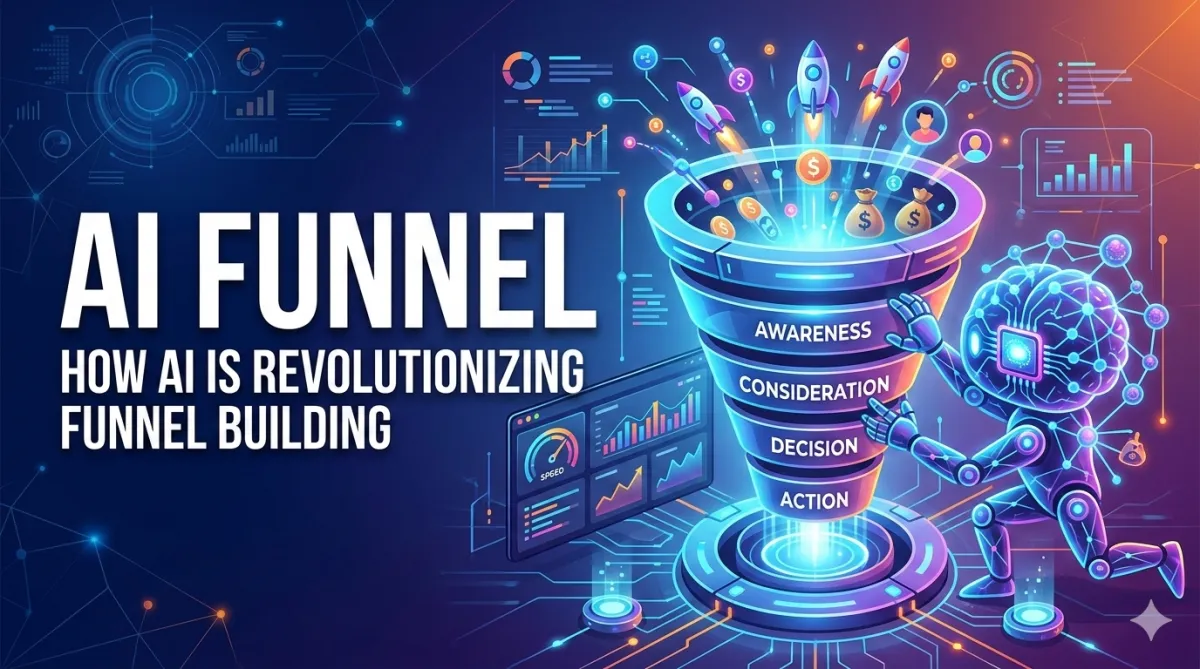
AI Funnel: How AI Is Revolutionizing Funnel Building
AI funnels are now a standard growth tool for many teams. Benchmarks show ROI improvements of 200–700%, conversion lifts of 20–40%, and roughly 31% lower customer acquisition costs when data and automation work together. An AI-powered sales funnel automates personalization and routing by combining dynamic content insertion, predictive lead scoring, conversational capture, and recommendation engines. Practically, that produces personalized hero copy, tailored product suggestions at checkout, chatbots that qualify and book meetings, and real-time score-based routing when data flows cleanly.
This guide covers what an AI funnel builder does, how an AI lead generation funnel applies capabilities at each stage, and which tool comparisons matter when you evaluate platforms. It walks through the toolbox: dynamic content, predictive scoring, conversational capture, and recommendation engines; offers concrete benchmarks such as qualified lead rate and demo no-show reduction; and stresses that results rely on clean data and fast iteration rather than shortcuts. If you run launches, sell high-ticket offers, or scale e-commerce, use the seven-step plan below to build an automated marketing funnel that runs 24/7 and to shortlist platforms that get you to revenue quickly.
What you need to know
Start with a few practical points that will guide your first tests and platform choices. Keep the scope narrow, measure the right KPIs, and scale the operations you need to run a funnel around the clock.
Core capabilities: An AI funnel combines dynamic content, predictive scoring, conversational capture, and recommendations to personalize and automate conversions in real time. Build toward these features instead of adding unrelated tools.
Start small: Test one high-impact element such as the hero headline or lead video on your busiest landing page for seven days. Use that short test to decide whether to roll the change out more broadly.
Tool selection: Match the builder to your use case and prioritize speed, simple A/B testing, and clean data integration. Avoid overbuilding features you won't use.
KPIs to track: Measure lead volume, qualified lead rate, MQL→SQL conversion, CAC, and demo no-show to attribute impact. Standardize definitions so teams don't argue over numbers.
Scale with ops: Automate routing, follow-ups, and recommendations once metrics prove lift. Partnering with a done-for-you production team shortens time-to-revenue.
What an AI-powered funnel actually does
An AI funnel combines four core capabilities to personalize, predict, and automate the buyer journey so your funnel behaves like a high-converting system. Those capabilities: dynamic content insertion, predictive lead scoring, conversational capture, and recommendation engines. The goal is to move prospects toward purchase without constant manual intervention.
Dynamic content insertion: Swaps page copy, images, and CTAs based on segment or behavior. It needs user context like UTM data and past interactions to work reliably.
Predictive lead scoring: Converts behavioral and firmographic signals into a ranked score for action. Training requires event history, demographic tags, and labeled conversion outcomes.
Conversational capture: Chatbots and automated follow-up emails gather intent signals, qualify leads, and book meetings. These systems depend on transcript logs, calendar availability, and clear handoff rules.
Recommendations and cross-sell engines: Suggest products at checkout or in nurture sequences using past purchases and browsing patterns. They increase average order value when recommendations match user intent.
Applied across the funnel, these capabilities improve conversion at every stage. Dynamic copy and CTAs lift top-of-funnel conversion, predictive scoring speeds qualification, chatbots reduce response times and demo no-shows, and recommendation engines increase average order value. Common implementations include swapping hero headlines by ad source, product suggestions at checkout based on cart behavior, chatbots that pre-qualify and book meetings, and real-time score-based routing to sales reps.
How an AI funnel personalizes experiences at scale
Dynamic content insertion powers personalization by swapping blocks on pages, emails, and ad creative using real-time rules. An AI funnel calls those rules from segmentation logic, CMS tokens, and APIs that query recommendation engines as soon as a user arrives. Use cases include swapping hero headlines by acquisition source, showing product tiles matched to inferred intent, and routing subscribers into different email sequences based on predicted readiness.
Implementation is mostly data plumbing and token mapping. Map the right data points to content tokens in your builder or CMS, then validate changes with controlled experiments. Typical mappings include UTM source to hero headline token, recent page views or search terms to product tile sets, and CRM stage or lead score to email sequence tokens.
Use APIs to fetch recommendations in real time and validate variations with A/B or multivariate tests. Predictive lead scoring distills many engagement signals into a single actionable number so workflows can act automatically. Keep models healthy by retraining regularly, injecting human-labeled examples, and monitoring for feature drift.
When you combine live content swaps with AI-driven lead qualification, your funnel becomes both more relevant and more efficient.
Choosing the right AI funnel builder for your tech stack
Match the platform to your use case so you don't overbuild. Convertri focuses on fast page loads and A/B optimization, Perspective targets mobile-first funnels with a built-in CRM and messaging, Heyflow emphasizes forms and lead scoring, Kartra works as an all-in-one automation hub, and Systeme.io offers a lower-cost option for simpler funnels and course launches. Pick the platform that fits your priorities and workflow rather than the one with the longest feature list.
Integrations and pricing determine whether a platform fits your stack. Check native CRM, GA4 and pixel support, calendar and payment gateway options, and whether the platform exposes APIs or Zapier paths. For pricing signals, Systeme.io tends to be lower cost, Perspective sits mid-to-high with native messaging, and Convertri's guide to the best AI funnel builders is a useful reference when speed and testing matter. Shortlist one or two platforms that match those fits.
Use a quick rubric to score options in a few minutes: list your priorities, score each criterion from one to five, and trial the top two platforms. Focus on these five criteria to compare objectively.
AI features: Auto-optimization, template generation, and lead scoring. Make sure these features work reliably and reduce manual effort.
Native CRM availability and messaging. Confirm how messages, contacts, and sales workflows sync with your stack to reduce integration work.
Analytics and GA4 support. Verify tracking and attribution are straightforward to set up and export for reporting.
Mobile performance and speed. Measure load times and conversion behavior on phones; mobile performance often drives ad efficiency.
Cost and support for your team size. Match pricing to expected volume and the level of agency or in-house support you need.
Run the same micro-test funnel on two platforms for seven to 14 days and compare speed-to-launch, conversion rates, and how easily you automate your AI-powered sales funnel. That split test beats feature spreadsheets and reveals which platform actually fits your process. Use the results to choose the right automated marketing funnel for growth.
Step-by-step: implement an AI-powered funnel in seven practical steps
The seven-step blueprint below is a copy-ready project plan for your next AI funnel. Each line can be pasted into your project board with a short what/why/how note so your team can execute quickly. Use this blueprint with your existing stack to speed setup and reduce guesswork.
Define funnel stages, conversion goals, and KPIs; baseline current metrics so you know what success looks like and where to focus optimization efforts. Document current conversion rates and volume for each stage so lift is measurable.
Set up data plumbing: CRM, GA4, tracking pixels, and consent capture so you collect reliable signals and stay compliant with consent rules. Confirm events fire correctly and map them to CRM properties for scoring and attribution.
Generate funnel pages with AI-assisted copy and templates; add dynamic tokens to personalize headlines, CTAs, and image swaps at scale. Keep templates minimal so tokens drive the main variations.
Deploy chat or conversational capture to collect intent signals and qualify leads in real time, routing high-intent prospects to sales or booking flows. Make sure bots surface clear handoff triggers and calendar availability. For a practical walkthrough, see astep-by-step guide to building a high-converting AI-driven sales funnel.
Build predictive scoring; map thresholds to routing and workflows so your sales team only gets prioritized leads and automation handles the rest. Start with a simple score and refine features as you collect labeled outcomes.
Automate nurturing sequences with personalization and product recommendations using AI sales automation rules to increase lifetime value. Layer in upsell and cross-sell paths based on behavior and purchase history.
Launch, measure, and iterate weekly using AI-driven A/B tests and model retraining to continuously improve conversion while reducing manual tweaks. Use short test cycles to validate creative and model changes before broader rollout.
Templates and prompts include a top-funnel quiz or lead magnet page, a mid-funnel demo sequence, and a bottom-funnel checkout with a one-click upsell. Two sample prompts you can reuse: 'Write ten headline variants for a seven-day course targeting coaches; emphasize outcome and scarcity' and 'Create five personalized subject lines for users who visited pricing but did not convert.' Also map form fields to HubSpot or Salesforce properties and fire custom events into GA4 for view_item, add_to_cart, and lead_submit. See curated top sales funnel templates and real-world examples for additional layouts and variations.
Run smoke tests, enable 24-hour monitoring for tracking and delivery, and perform a seven-day performance review to adjust scoring and creative. After the week you will have concrete lift signals to iterate on before scaling. Decide whether to expand personalization or lock winning components for broader rollout.
Measure ROI and choose a partner to scale (why Efficient Growth Media helps)
Begin by tracking KPIs that let you attribute impact cleanly: lead volume, lead quality rate, MQL→SQL conversion, CAC, LTV, and Marketing Efficiency Ratio (MER). Use consistent formulas for reporting: MER = Revenue / Spend, and ROI = (Incremental revenue − AI/project cost) / AI/project cost. Clear definitions remove debate and speed decisions. For frameworks on attribution and ROI measurement, review resources on measuring the ROI of AI in marketing.
Benchmarks give context. Aim for a MER of 4–5 on launch-focused funnels; a strong baseline ROI sits around 200–300%, while top performers exceed 700% when campaigns target high-intent audiences and teams iterate quickly. Faster payback comes when AI segments high-intent audiences and removes manual handoffs.
If you need speed and certainty, work with a partner that executes the full stack and measures KPIs from day one. Efficient Growth Media follows a reproducible playbook covering discovery, data integration, model selection, creative production, automation wiring, and rapid iteration. Typical deliverables include a Launch Your Course in 7 Days | DFY Funnel System for Coaches, tailored templates, and monthly reports that surface score distributions and ROI.
Discovery and KPI definition
Data map and integration
AI model selection and prompt engineering
Production of creative assets
Automation wiring and sequencing
Rapid A/B testing and iteration
For example, a coaching client improved conversion from 2% to 6% while cutting CAC by 40% after predictive scoring and creative optimizations. Those results depended on clean data and fast iteration rather than ad hoc changes.
An AI funnel is a system, not a single tool, so judge platforms by their ability to move MER and incremental ROI. Use the rubric above to shortlist platforms, run a fast pilot with the seven-step blueprint, and scale only on repeatable profit signals. To run the initial test for you, Efficient Growth Media can deliver the pilot, hand over winning components, and set your funnel to run 24/7; request a funnel audit or a plug-and-play sprint to get started — or book a Conversion Rate Optimization Funnel Design session for hands-on strategy and execution.
Learn more about our approach in the Conversion Rate Optimization Funnel Design materials.
Why an AI funnel changes how you scale
An AI funnel combines personalization, prediction, dynamic content, and automation to replace one-size-fits-all funnels with systems that learn and improve. Real-time audience signals let you swap page or email blocks to match intent and lift engagement without adding manual work. Predictive routing and automated follow-ups let the funnel learn who is most likely to buy and serve the right next step automatically.
THANKS FOR READING
Ready to Scale? Here's How We Can Work Together
If you're ready to stop figuring it out alone and want a funnel system that actually converts — let's talk.
I offer Done-For-You (DFY) funnel builds for course creators, coaches, and digital product businesses.
👉 Let's Build Your Revenue System
👉 Book A Discovery Call
👉 Send Me A WhatsApp
👉 Email: [email protected]
📺 Learn More on YouTube
Want to see these strategies in action? I break down funnels, content systems, and growth tactics every week.
👉 Subscribe to my YouTube Channel
My Full Gear List 👉 Everything I use to film and create
🛠️ Tools I Use & Recommend
These are the exact tools I use to build funnels, grow audiences, and run my business. The links below are affiliate links they cost you nothing extra and help support this content. Thank you! ❤️
All-in-One Business Platform:
👉 Course Creator 360 (CC360)
► Course hosting, marketing automation, and DMs. Everything in one
👉 Course Creator Pro
► The step-by-step system for creating and launching your online course.
YouTube Growth Tools
👉 🤖 VidIQ — AI-powered YouTube growth and keyword research.
👉 🔴 Tubebuddy — The go-to research tool for YouTube creators.
Video Editing & Production
👉 🎨 DeHancer — Professional film emulation, grain, and color tools.
Use code "MAIK" for 10% off.
👉 🎶 ARTLIST — Royalty-free music and SFX for your videos.