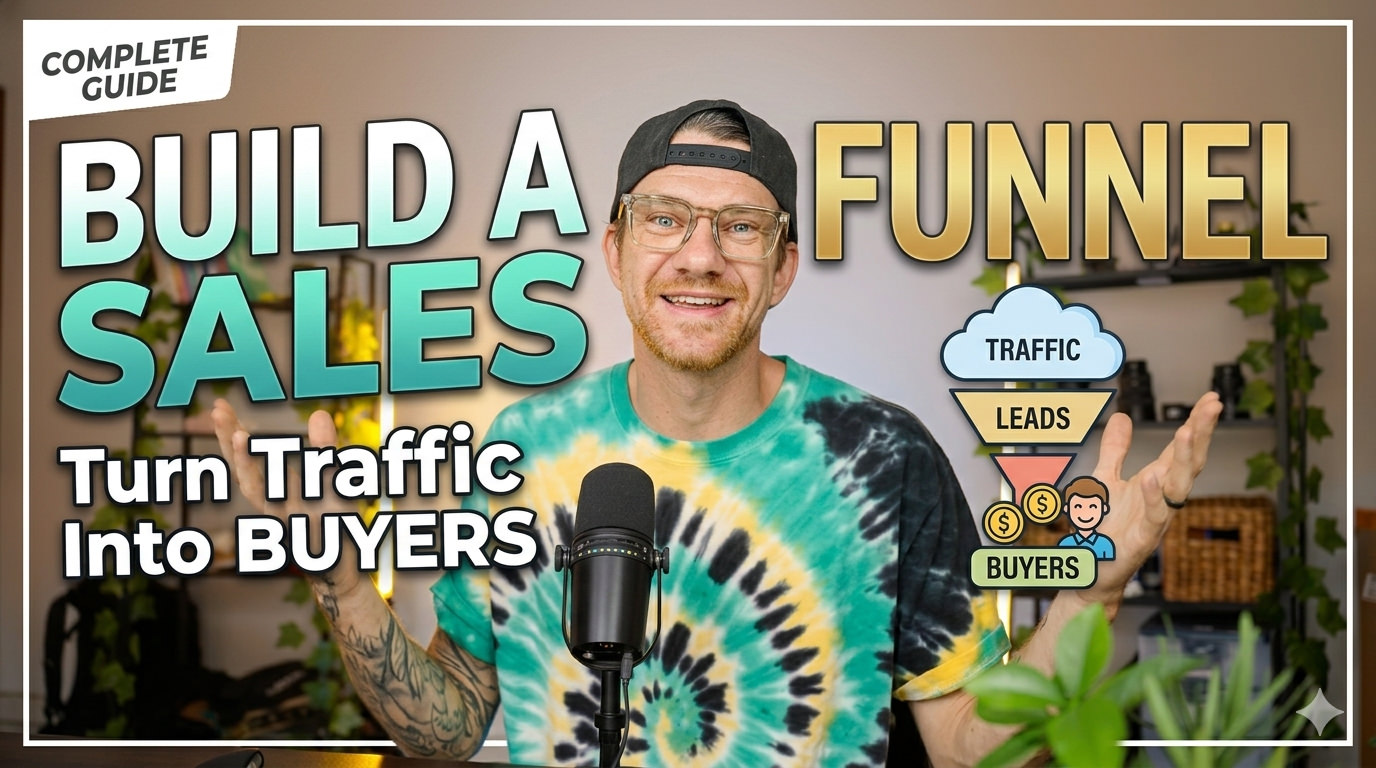
How to Build a Sales Funnel That Turns Traffic Into Buyers
Introduction
Most businesses today are trying to generate more leads, more traffic, and more visibility online.
But traffic alone doesn’t create revenue.
What actually turns strangers into customers is a sales funnel.
A well-built sales funnel guides someone from discovering your business to becoming a paying customer. It structures the entire journey from the first ad or piece of content they see, all the way to the moment they buy.
The problem is that many entrepreneurs build funnels that don’t convert.
They focus on tools, pages, and technology but ignore the psychology that makes funnels work.
The highest-performing funnels follow a few core principles:
Clear messaging
Strong psychology
A structured customer journey
High-value offers
In this article, you’ll learn the key elements behind a sales funnel that actually converts traffic into buyers. These ideas come from real-world funnel strategies used by successful online businesses to generate millions in revenue.
How to Build a Sales Funnel That Turns Traffic Into Buyers
What a Sales Funnel Actually Is
The Simple Framework Behind Every Funnel
Why Small Funnel Tweaks Can Change Everything
The Power of “New Opportunity” Offers
Why Webinar Funnels Work So Well
Typical Webinar Conversion Benchmarks
The Role of Psychology in Funnel Success
What is the purpose of a sales funnel?
Do sales funnels still work today?
What is the most important part of a funnel?
What a Sales Funnel Actually Is
A sales funnel is the structured process someone goes through before buying from you.
Instead of sending people directly to a sales page, funnels guide them through stages of trust and understanding.
A typical funnel might look like this:
Ad or social content
Landing page
Email capture
Webinar or training
Sales offer
Upsell or recurring product
Each step moves the customer closer to buying.
The key insight is this:
People rarely buy the first time they see something.
A funnel solves that problem by building trust step by step.
The Simple Framework Behind Every Funnel
High-performing funnels follow a simple structure.
Every page, ad, and message inside a funnel includes three elements:
Hook
The hook grabs attention.
It stops someone from scrolling and makes them curious enough to click.
Examples:
A surprising statement
A bold claim
A curiosity-driven headline
A problem the audience recognizes
Example hook:
“The loophole we discovered that helps businesses generate leads without ads.”
The goal of the hook is not to sell.
It’s to create curiosity.
Story
The story builds emotional connection and credibility.
Stories help people understand:
who you are
why your method works
why they should trust you
Most effective marketing stories follow this pattern:
Struggle
Discovery
Breakthrough
This is often called an epiphany story.
For example:
You struggled with a problem
Tried many solutions that failed
Eventually discovered a new approach
This shows the audience that you understand their problem.
Offer
The final piece is the offer.
This is where you present the solution.
A good offer explains:
what the product is
what transformation it creates
why it’s valuable
how to get started
If the hook grabs attention and the story builds trust, the offer becomes a natural next step.
Why Small Funnel Tweaks Can Change Everything
One of the most overlooked parts of funnel optimization is messaging.
Small changes in headlines and positioning can dramatically improve results.
For example:
A webinar registration page might say:
“Learn how to make money helping businesses get more reviews.”
This explains the topic.
But it lacks curiosity.
A better version could be:
“The overlooked loophole businesses use to generate extra revenue from local reviews.”
The second headline creates curiosity.
When people feel they don’t know the answer yet, they are more likely to register and attend.
These small psychological shifts can reduce advertising costs and dramatically improve funnel performance.
Why Value Beats Lower Prices
Many businesses try to compete by lowering prices.
This usually leads to shrinking margins and weak offers.
A stronger strategy is to increase perceived value.
Instead of lowering your price, add more value.
For example:
Instead of selling a $50 product alone, bundle it with:
templates
bonuses
training
community access
Now the offer feels much larger than the price.
This changes the psychology of the purchase.
Customers feel they are getting a great deal, even if the price stays the same.
The Power of “New Opportunity” Offers
Another key concept in high-converting funnels is positioning your offer correctly.
Most offers fall into two categories:
Improvement Offers
These promise a better version of something that already exists.
Examples:
Faster weight loss
Better productivity systems
Improved marketing tools
The problem is that many people have already tried similar solutions and failed.
So they become skeptical.
New Opportunity Offers
These introduce something completely different.
Instead of saying:
“This is a better way to do funnels.”
The message becomes:
“Most marketing systems are broken. This is a completely new approach.”
New opportunity offers remove blame from the customer.
They say:
It wasn’t your fault.
The system you used before was flawed.
This is a new way.
This positioning dramatically increases interest and conversions.
Why Webinar Funnels Work So Well
One of the most powerful funnel types is the webinar funnel.
Webinars work because they combine:
education
storytelling
trust
selling
During a webinar, someone spends 60–90 minutes with you.
That level of attention builds a much stronger relationship than a simple ad or post.
A typical webinar funnel includes:
Webinar registration page
Webinar presentation
Special offer at the end
This structure warms up cold audiences quickly.
Someone who had never heard of you can become a customer within a single webinar.
The Biggest Webinar Mistake
Many people make one critical mistake when teaching on webinars.
They teach too much.
The purpose of the webinar is not to give away everything.
Instead, the goal is to teach the what, not the how.
For example:
You might teach a framework like:
Identify a proven funnel
Study how it works
Map the funnel structure
Build your version
That’s the strategy.
The tactics — how to build each page, write copy, and launch ads — come inside the paid program.
This structure does two things:
It inspires the audience
It positions your product as the implementation path
Typical Webinar Conversion Benchmarks
A strong webinar funnel usually looks like this:
Registration rate
30–50% of visitors register.
Show-up rate
20–30% of registrants attend.
Sales conversion
5–10% of attendees buy.
Rough example:
If 100 people attend a webinar:
5 sales = strong webinar
10 sales = exceptional webinar
These numbers can generate significant revenue when the webinar is run consistently.
Why Niches Matter for Funnels
Many entrepreneurs try to target everyone.
This makes marketing harder and more expensive.
Instead, successful funnels start with a specific niche.
A simple way to find your niche is:
Target the person you were 5 years ago.
You understand their problems.
You understand their goals.
You know what they tried before.
That allows you to speak directly to their situation.
Once you dominate a small niche, you can expand into larger markets later.
The Role of Psychology in Funnel Success
Funnels are not just about technology.
They are about psychology.
Successful funnels consider things like:
curiosity
perceived value
status
trust
exclusivity
People buy when they believe the result will increase their status.
Status can mean:
earning more money
improving health
gaining recognition
achieving success
Your funnel messaging should clearly show how the offer improves the customer’s life.
FAQ
What is the purpose of a sales funnel?
A sales funnel guides potential customers through a structured journey from discovery to purchase. It helps businesses build trust, educate prospects, and present offers at the right moment.
Do sales funnels still work today?
Yes. Sales funnels remain one of the most effective marketing strategies because they structure the buying process and increase conversion rates.
What is the most important part of a funnel?
Messaging and offer positioning are often more important than the technology. A strong hook, compelling story, and valuable offer are essential.
Why are webinar funnels effective?
Webinars build trust quickly because they allow businesses to educate prospects in real time. A well-structured webinar can turn cold traffic into buyers within a single presentation.
Should I start with a niche?
Yes. Starting with a clear niche allows you to target your messaging more effectively and reduce competition. Once you gain traction, you can expand into larger markets.
Conclusion
Building a sales funnel that converts traffic into buyers isn’t about complicated tools or flashy pages.
It comes down to a few core principles:
A strong hook that grabs attention
A story that builds trust
A clear offer that solves a real problem
Positioning your solution as a new opportunity
Increasing perceived value instead of lowering price
Using webinars or structured content to build relationships
When these elements work together, funnels become powerful growth engines for online businesses.
Instead of hoping people buy, you guide them through a journey that makes the decision clear and natural.
Want Help Building a Funnel Like This?
If you want help creating a conversion-focused funnel system for your course, coaching program, or digital product, I help creators and coaches install revenue-ready funnel systems.
👉 Let's Build Your Revenue System
👉 Book A Discovery Call
These systems include:
offer positioning
funnel design
copywriting
automation
webinar or VSL funnels
THANKS FOR READING
Ready to Scale? Here's How We Can Work Together
If you're ready to stop figuring it out alone and want a funnel system that actually converts — let's talk.
I offer Done-For-You (DFY) funnel builds for course creators, coaches, and digital product businesses.
👉 Let's Build Your Revenue System
👉 Book A Discovery Call
👉 Send Me A WhatsApp
👉 Email: [email protected]
📺 Learn More on YouTube
Want to see these strategies in action? I break down funnels, content systems, and growth tactics every week.
👉 Subscribe to my YouTube Channel
My Full Gear List 👉 Everything I use to film and create
🛠️ Tools I Use & Recommend
These are the exact tools I use to build funnels, grow audiences, and run my business. The links below are affiliate links they cost you nothing extra and help support this content. Thank you! ❤️
All-in-One Business Platform:
👉 Course Creator 360 (CC360)
► Course hosting, marketing automation, and DMs. Everything in one
👉 Course Creator Pro
► The step-by-step system for creating and launching your online course.
YouTube Growth Tools
👉 🤖 VidIQ — AI-powered YouTube growth and keyword research.
👉 🔴 Tubebuddy — The go-to research tool for YouTube creators.
Video Editing & Production
👉 🎨 DeHancer — Professional film emulation, grain, and color tools.
Use code "MAIK" for 10% off.
👉 🎶 ARTLIST — Royalty-free music and SFX for your videos.